



The History of Virtual Reality: From the 1950s to Today
📋 In brief: When was virtual reality invented and how has it evolved?
Virtual reality was born in 1957 with Morton Heilig's Sensorama, more than 60 years before today's consumer headsets. From classified military prototypes to 4.6 million Meta Quest 2 units sold in a single quarter, VR has gone through six decades of innovation to become a technology accessible to everyone.
- 1957: first immersive machine, the Sensorama (Morton Heilig)
- 1968: first functional VR headset, the Sword of Damocles (Ivan Sutherland)
- 2016: first commercially available consumer headset, the Oculus Rift
- 2021: 4.6 million Meta Quest 2 units sold in a single quarter
- 2024: Meta Quest 3 (mixed reality) and Apple Vision Pro on the market
Virtual reality (VR) is a technology that allows users to be immersed in a simulated 3D environment. Contrary to what one might think, its origins date back over 60 years: VR is the result of the perseverance of bold visionaries who believed in their inventions and pushed the boundaries of what we thought possible at the time.
Discover the history of virtual reality and how this revolutionary technology has evolved from the 1950s to today.
Timeline of Key Dates in Virtual Reality
The history of virtual reality (VR), a bridge between our physical world and digital universes, goes back much further than many imagine, with key developments spanning several decades.
The Pioneers of Virtual Reality (1950-1970)
Morton Heilig's Sensorama (1957):
It was in 1957 that filmmaker Morton Heilig invented the “Sensorama,” a machine designed to immerse users in an imaginary world, offering a new cinematic experience. Later in 1960, he filed a patent for his idea.
Ivan Sutherland's Sword of Damocles (1968):
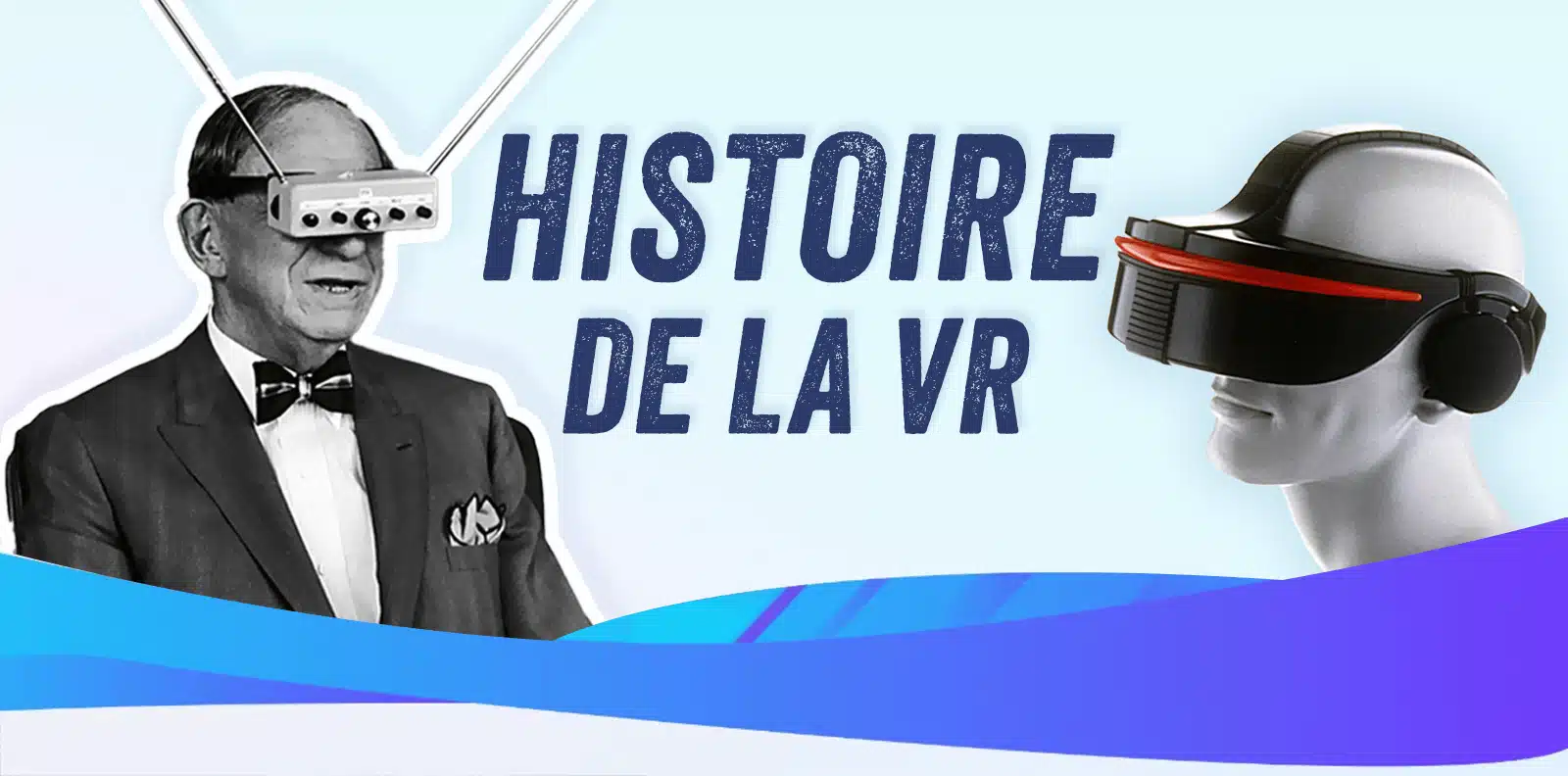
In 1968, Ivan Sutherland created the Sword of Damocles, considered the first functional VR headset. The “headset” was too heavy to be commercialized, but it could display simple shapes that changed perspective based on the user's head movements.
Thomas Furness's “Super Cockpit” (1970):
In 1970, military engineer Thomas Furness developed the “Super Cockpit,” an immersive flight simulator for the military. This project, which spanned over 10 years, resulted in a training cockpit capable of projecting computer-generated 3D maps and real-time data. It was therefore the first virtual reality flight simulator!
The Era of Concepts and VR Prototypes (1970-1990)
In 1973, Myron Krueger coined the term “artificial reality.”
In 1978, the ancestor of Google Earth VR was born. Developed by MIT and DARPA, Aspen Movie Map allowed users to visit the city as if they were there. This invention marks the beginnings of interactivity offered by VR.
In 1991, the first virtual reality headset dedicated to gaming was born: The Sega VR. However, the project was never commercialized for fear of failure.
The VR Revolution (2000-2015)
From 2010 to 2012, the democratization of virtual reality began. It started with the emergence of the Oculus Rift, created by Palmer Luckey.
In 2014, Facebook (now Meta) acquired Oculus, marking the entry of tech giants into the VR domain.
BANNIERE-MID : IRWINO
The Democratization of Virtual Reality (2016-2019)
In 2016, the first commercial version of the Oculus Rift was launched, an important step toward mass-market accessibility of VR.
In 2017, VR became embedded in society with numerous companies developing their own headsets. We also saw the emergence of practical applications, such as first aid VR training
In 2019, the Oculus Quest was born, a standalone wireless headset that revolutionized the VR experience by making it more accessible and comfortable. 2020 marked the arrival of SST VR and FIRE VR with standalone headsets!
Recent Innovations and Current Trends in Virtual Reality (2020-2024)
In 2020, the Meta Quest 2 (formerly Oculus Quest 2) was launched. In the first quarter of 2021, Meta shipped over 4.6 million headsets, demonstrating the global enthusiasm around virtual reality.
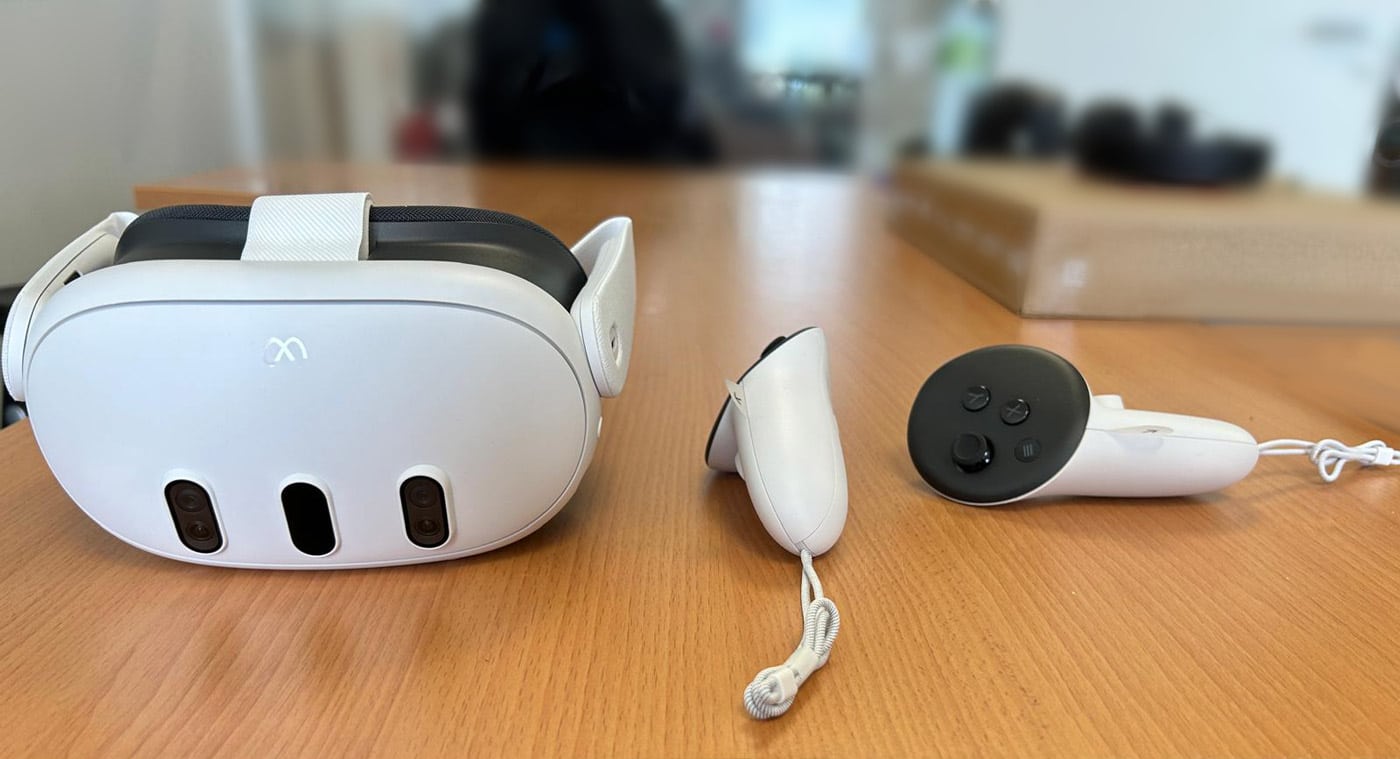
In 2023, the Meta Quest 3 succeeded the Meta Quest 2. It merges virtual reality and augmented reality and introduces the term mixed reality. Discover Meta Quest 2 vs Meta Quest 3 differences.
In 2024, the Apple Vision Pro was released, a mixed reality headset that integrates iOS to access Apple services in virtual spaces.
The Future of Virtual Reality
The history of virtual reality is a fascinating testament to human capability. Today, virtual reality continues to evolve and find new applications across various fields, from education to entertainment, including professional training and scientific research.
The same goes for augmented reality, which is becoming a learning tool for workplace fire training, as illustrated by IKEA's fire training with FIRE VR and FIRE AR.
IRWINO places innovation at the heart of its priorities and sees in virtual reality the future of training. If these are also your beliefs, don't hesitate to contact us for more information.
BANNIERE-FIN : IRWINO
Key Takeaways
When was virtual reality invented?
Virtual reality was invented in 1957 by filmmaker Morton Heilig with the Sensorama, an immersive machine combining image, sound and physical sensations. It is therefore a technology over 60 years old, long before the consumer headsets we know today.
What was the first virtual reality headset in history?
The Sword of Damocles, designed by Ivan Sutherland in 1968, is considered the first functional VR headset. Too heavy to be commercialized, it displayed simple 3D geometric shapes that adapted to the user's head movements, laying the foundations for all modern VR headsets.
When did virtual reality become accessible to the general public?
The democratization of virtual reality began in 2016 with the commercial launch of the Oculus Rift. The Oculus Quest (2019) accelerated the movement by removing the cable, and in 2021 Meta shipped 4.6 million Quest 2 headsets in a single quarter, confirming the mass adoption of VR.
What is virtual reality used for in professional training today?
Virtual reality enables employees to train in simulated environments without real risk: fire safety, first aid, workplace safety. Solutions like our VR fire simulator and FIRE AR by IRWINO deploy these simulations directly in the workplace, in VR, AR and XR, for immersive and lasting learning.
Related articles

Meta Quest 3 vs Meta Quest 2: Everything You Need to Know
Do you know the difference between the Meta Quest 2 and Meta Quest 3? To learn more, check out our article.
Read article
What Are the Differences Between Virtual Reality and Augmented Reality?
What are the differences between virtual reality and augmented reality?
Read article
What Are the Differences Between 3D Virtual Reality and 360 Video?
What are the differences between 3D virtual reality and 360 video?
Read articleDiscover our solutions
Immersive simulators to transform your training

FIRE AR
Augmented reality fire training simulator, for EPI training directly in your premises, with real virtualized extinguishers.
Discover
FIRE VR
3D fire training simulator. 3 environments (office, industry, healthcare ERP) and over 50 scenarios.
Discover
SST VR
Workplace first aid training in virtual reality. 15 realistic case study scenarios.
Discover